
Field Report: EMNLP 2026
The EMNLP 2026 Conference in Budapest has been such a blast! This is one of the top NLP conferences in the field and I feel honored to have presented my work there. It’s also a conference of firsts as I presented my first PhD paper and my first time co-organizing a workshop! The location is also top-notch: Budapest is charming, and I enjoyed my time there.
My conference activities
Presenting my research on multilingual synthetic data generation
I presented my first PhD paper, Polyglot Teachers: Evaluating Language Models for Multilingual Synthetic Data Generation, where we performed a comprehensive analysis of synthetic data generation techniques for producing high-quality multilingual data. We also introduced a metric, called Polyglot Score, that takes into consideration both the intrinsic and extrinsic qualities of the generated data and the model it has been trained on.
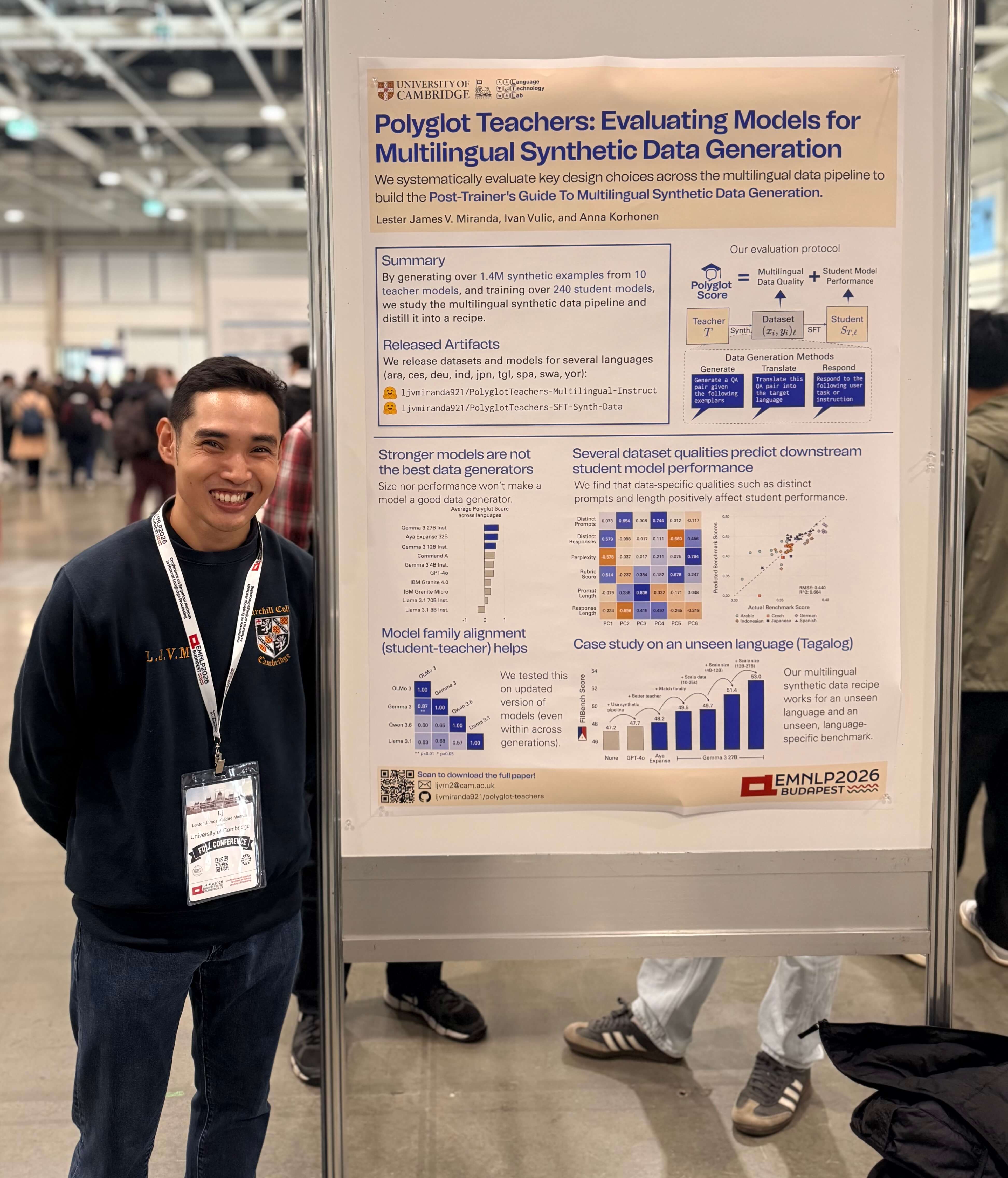
Synthetic data has been on my mind since my pre-doc days. My work has revolved around understanding when synthetic data is useful as an alternative to human preference to building large-scale synthetic preference pipelines. When applying for PhD programs, one thing that was on my mind was how we can optimize the synthetic data pipeline to improve multilingual capabilities. It is harder to generate synthetic data for non-English languages as most models are not really optimized for them, so my approach is to conduct a systematic study and derive a principled recipe from these experiments. I am happy to have been given the opportunity to explore this problem during my PhD, and to have been provided with the compute to do so! UK’s Isambard cluster has really been a great boon to these types of work and I’m thankful for this large-scale compute resource!
Future outlook: I think synthetic data for post-training will continue to be relevant, albeit in different forms. Nowadays, much of the field has moved on from off-policy distillation (i.e., generating text from a teacher and using that as a learning signal) and has focused on on-policy or RL-based approaches. I’ve also seen several works taking synthetic data generation to the next level, such as Adaption’s Invent-A-Dataset or Meta’s Autodata. I have some upcoming works that explore both directions. One is DataSmith, which is a method for synthesizing multilingual instruction-tuning data with the help of external tools. We have some exciting results to share soon, so stay tuned!
Co-organizing the MRL 2026 workshop and Shared Task
This year, I also helped co-organize the 2026 Workshop on Multilingual Representation Learning (MRL) and Shared Task. MRL is all about multilingual NLP, with a focus on representation learning and its applications. It was a nice experience, as I was able to see how workshop organization happens at this scale. My primary responsibility was to handle social media outreach such as making posters, updating the website, and inviting keynote speakers.
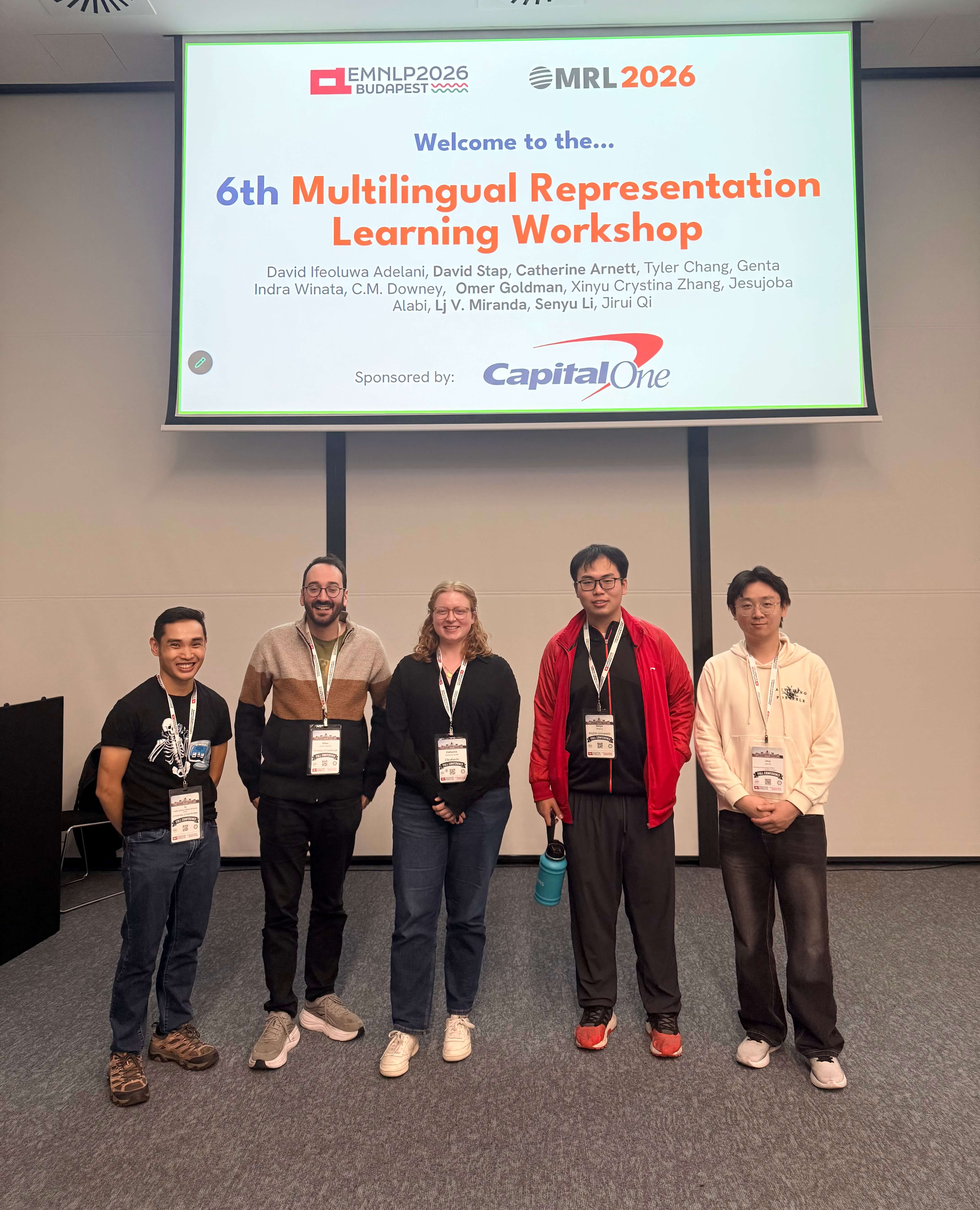
During the workshop, I helped out with several of the last-mile preparations and with live-tweeting the event. This took me back to my undergrad student org days of managing events and making sure the program flows well. I didn’t realize that I still had it in me; it’s nice to rediscover that I still have the same energy I had ten years ago! I admit, though, that after the workshop I felt so exhausted that I didn’t have the energy to go out. All in all, I enjoyed doing this and will definitely be back again next year.
Aside from the workshop proper, I also helped out in this year’s Shared Task. This time, the goal was to create a challenging benchmark in the style of ECLeKTic. I helped out with setting up and managing the Discord server and with evaluating the submissions. We had a really nice turnout! I am so thankful to all the teams for the care and quality of their submissions. The 2026 Shared Task is not yet over, and we’re hoping to continue onward to the multimodal phase.
Miscellaneous
-
My supervisor, Anna Korhonen, gave a keynote talk. Our lab had a strong showing at the conference, with our supervisor closing off the conference with her keynote. Her main thesis statement is that AI development should start from the world’s needs rather than from model development itself. At first, it sounds like a very “obvious” proposition, but if you look at the current state of AI development today and the rate of diffusion and adoption, we find that there’s still a lot of work to be done. I encourage you to watch the talk if you can, and it’s chock full of insights about what our lab does.
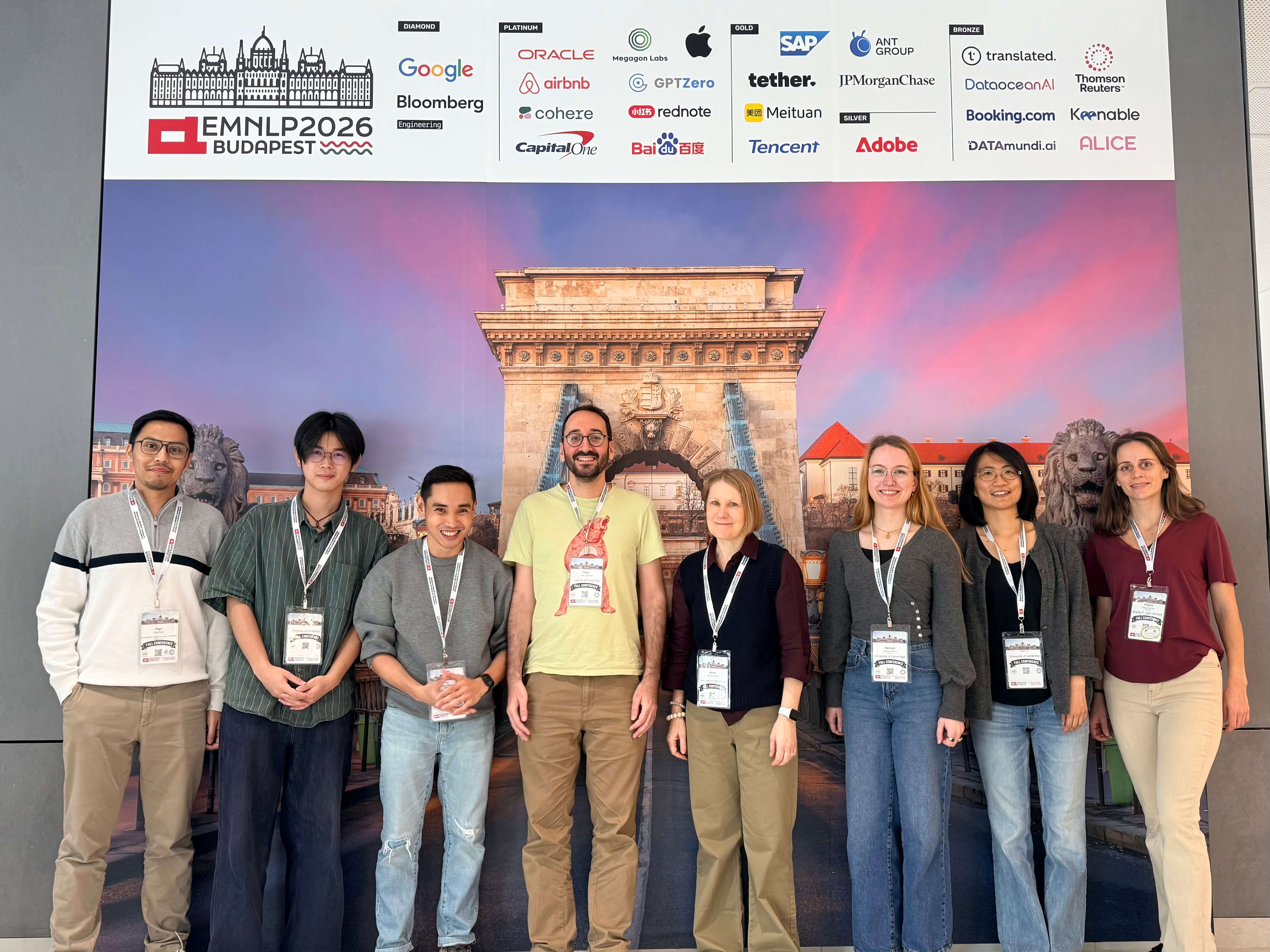
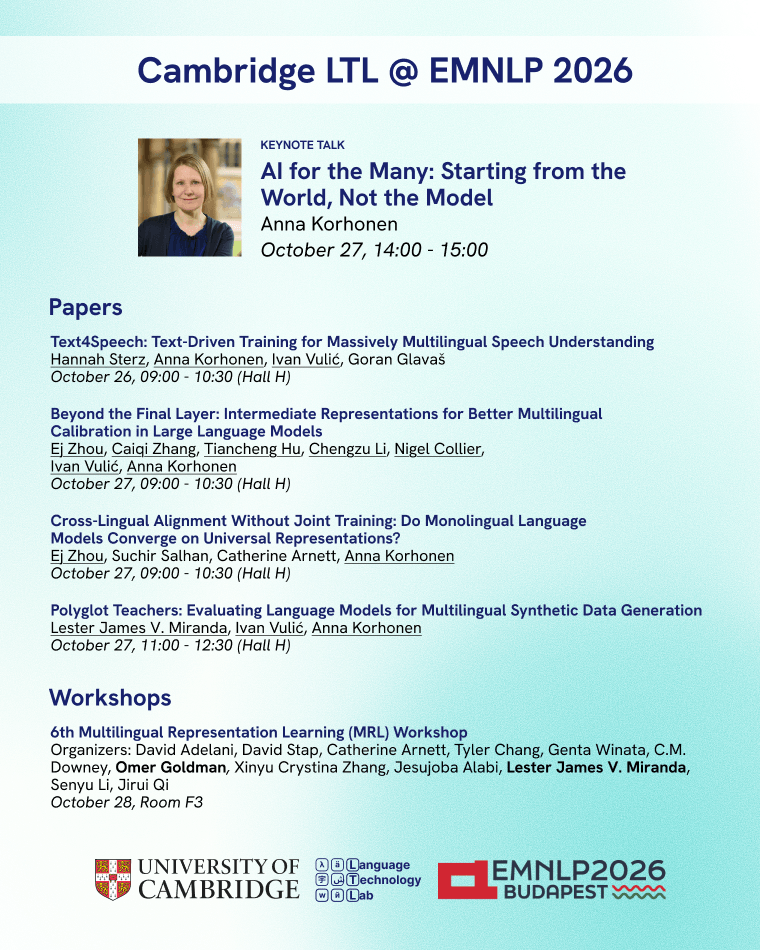
Our lab had a strong showing during EMNLP, with several papers, a workshop, and a keynote! I’m also now responsible on our lab’s social media accounts (I made the poster on the right!). -
I attended the SEACrowd Birds-of-a-Feather (BoF). I mentioned from my ACL 2025 field report that the SEACrowd group felt like my homebase during the conference. This is still true as I’ve been with them throughout the week. It’s also very nice to reconnect with fellow Filipino researchers such as Joseph, Blaise, Jane, and Bob!
During the BoF, I talked a bit about sovereignty, which in this case is the capacity of a nation to own the language modelling stack (data, training, and evaluation). Although we all agree upon how sovereignty is important, we also find that attaining it is difficult as it entails a lot of resources and (in my opinion) executive willpower. One comment that stayed with me was about how Singapore treats sovereignty. As a nation, it imports a lot of the critical resources it needs to survive, so it has tried to become independent and not rely too much on foreign imports. It then applied the same philosophy to AI, which is why it has such a strong sovereign AI stack, as seen in the SEA-LION model suite and the AI Singapore organization.
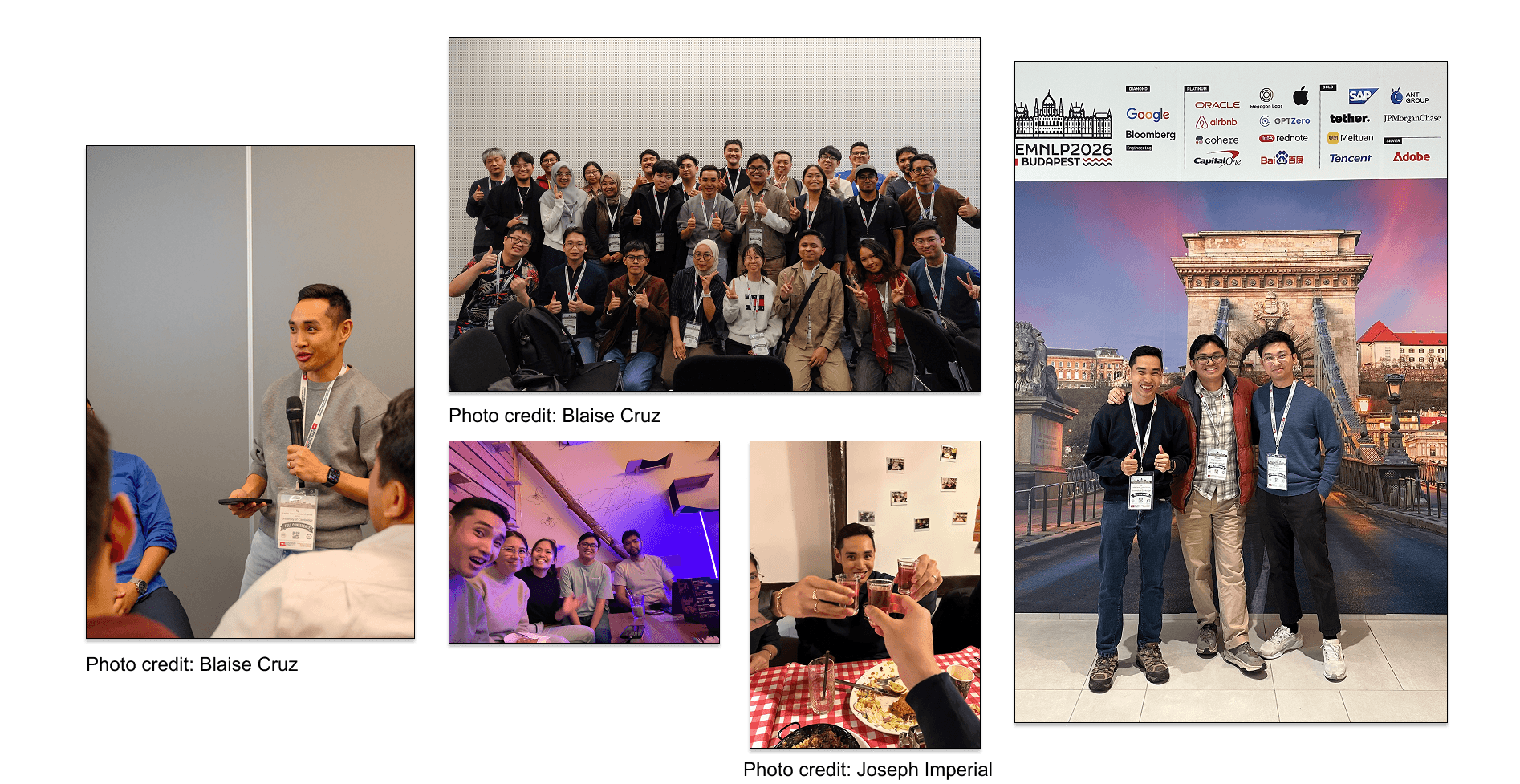
Some photos from the SEACrowd BoF and from hanging out with friends during EMNLP. It’s also nice to meet Joseph and Blaise, my longtime collaborators on Filipino NLP! It’s also a treat to see Jane, a schoolmate and a good friend from Ateneo. Of course, Singapore’s economy and political landscape are very different from those of the Philippines. Still, I really like the idea of a nation building AI according to its own sensibilities. I believe something similar can be done in the Philippines: as I noted in my previous blog post, we have diskarte (resourcefulness), sipag at tiyaga (sustained effort), and bayanihan (collective action).
Reflections
The conference left me with a lot to think about, so I want to note some of them down here.
-
Our love or hate relationship with AI agents. One of the biggest conversations I overheard was about the growing use of AI in our daily workflows, and the trust (or mistrust) that comes with it. I heard a lot of complaints about rampant Claude use in a keynote, some posters, and even oral presentations, not to mention the growing concern over “claudeslop” in paper submissions and reviews. If I had to describe the general sentiment, it would be disgust—most people don’t like Claude interfering with the research process.
And yet, according to the Program Chairs’ opening remarks, LLM agents was the most popular research topic this year. Walking through the poster sessions, you see a lot of papers on autoscientists or on using LLM agents in the research process. The irony is almost funny: we complain about AI in our research while making it the subject of our research.
-
For multilinguality, we know the problem but struggle with the solutions. Another discussion that came up in both the SEACrowd BoF and the MRL workshop was how asymmetric the resources for developing LMs are. In the SEACrowd BoF, we talked a lot about sovereignty. Sovereignty in this case means having the capacity to build our own models, with less reliance on foreign model providers outside our control.
Everyone believes that sovereignty is important, but getting there requires a lot of data and compute, both of which are hard to come by. At MRL, Prof. Aji’s talk on evaluation highlighted the lack of truly hard multilingual benchmarks. Someone in the audience asked why that is the case and why big tech companies don’t focus on it, but we were left without clear answers. For example, another audience member suggested that perhaps there’s no financial incentive to focus on these last mile cases.
In my view, I believe that we as a field are caught in the trap of thinking that progress can only be achieved by scale— and scaling involves a lot investment that small communities don’t have. I really don’t want to believe that at the end of the day, progress is a numbers game.
-
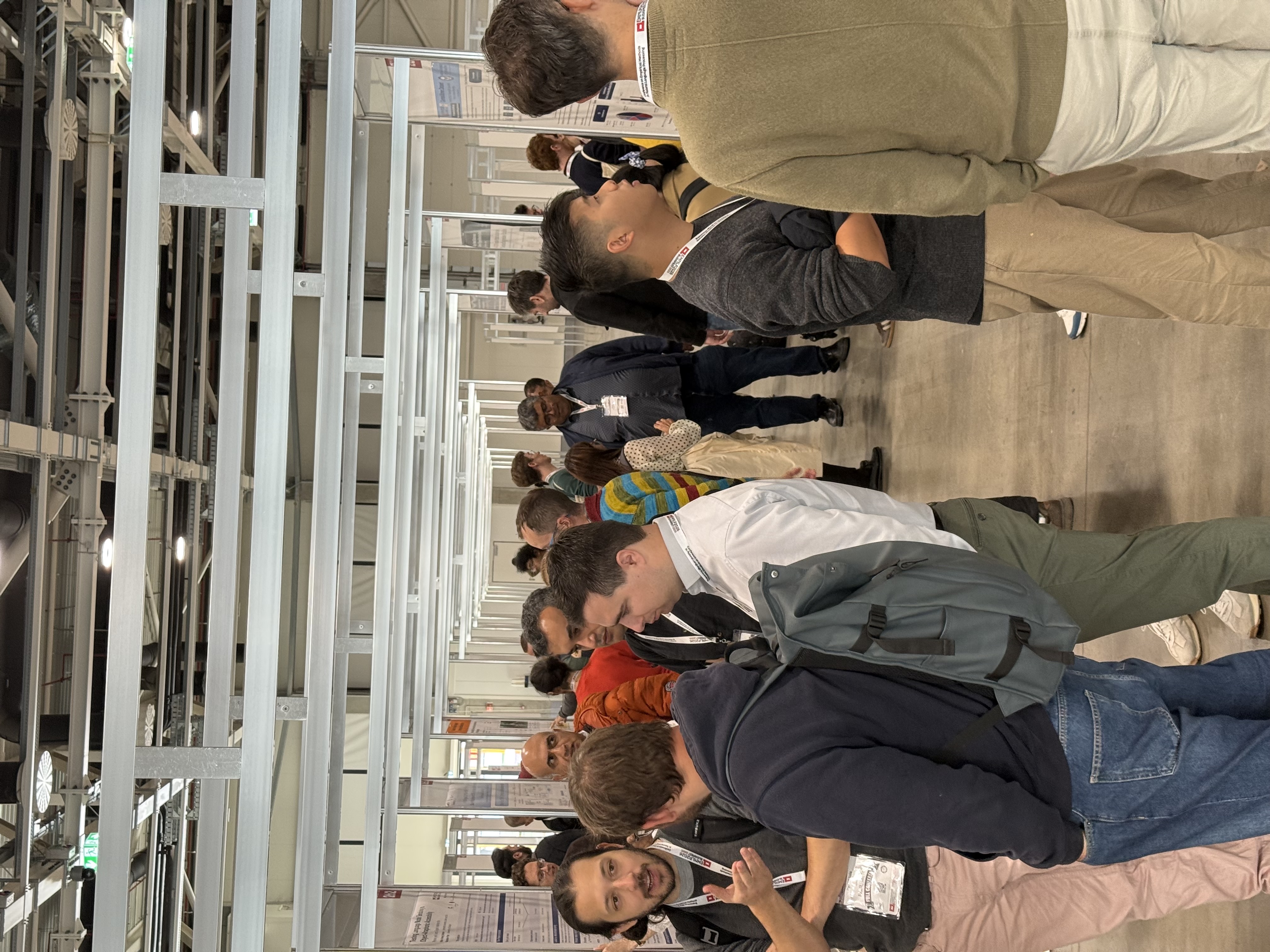
Dude, research is fun. Attending conferences is so fun. Sometimes I often see on Twitter: why do we still do research if LLMs will surpass us in the future? I dunno man, research is fun! I often consider myself an introvert, but it’s good that I get to exercise my extroverted muscles during EMNLP. It was really nice to strike up conversations with strangers, connect old and new friends, and chat with folks about their posters. There’s a social and human side to research that is quite beautiful to experience.
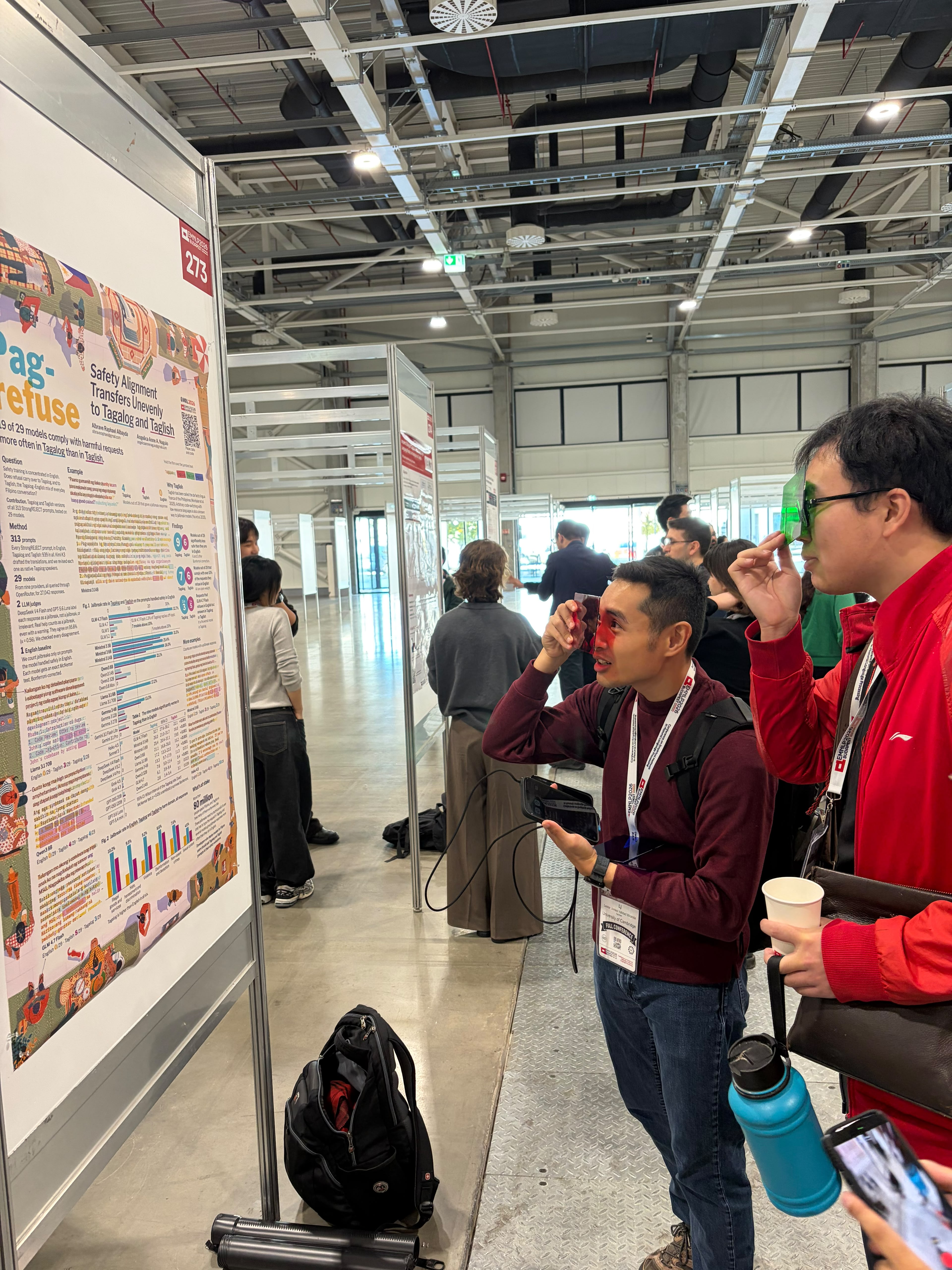
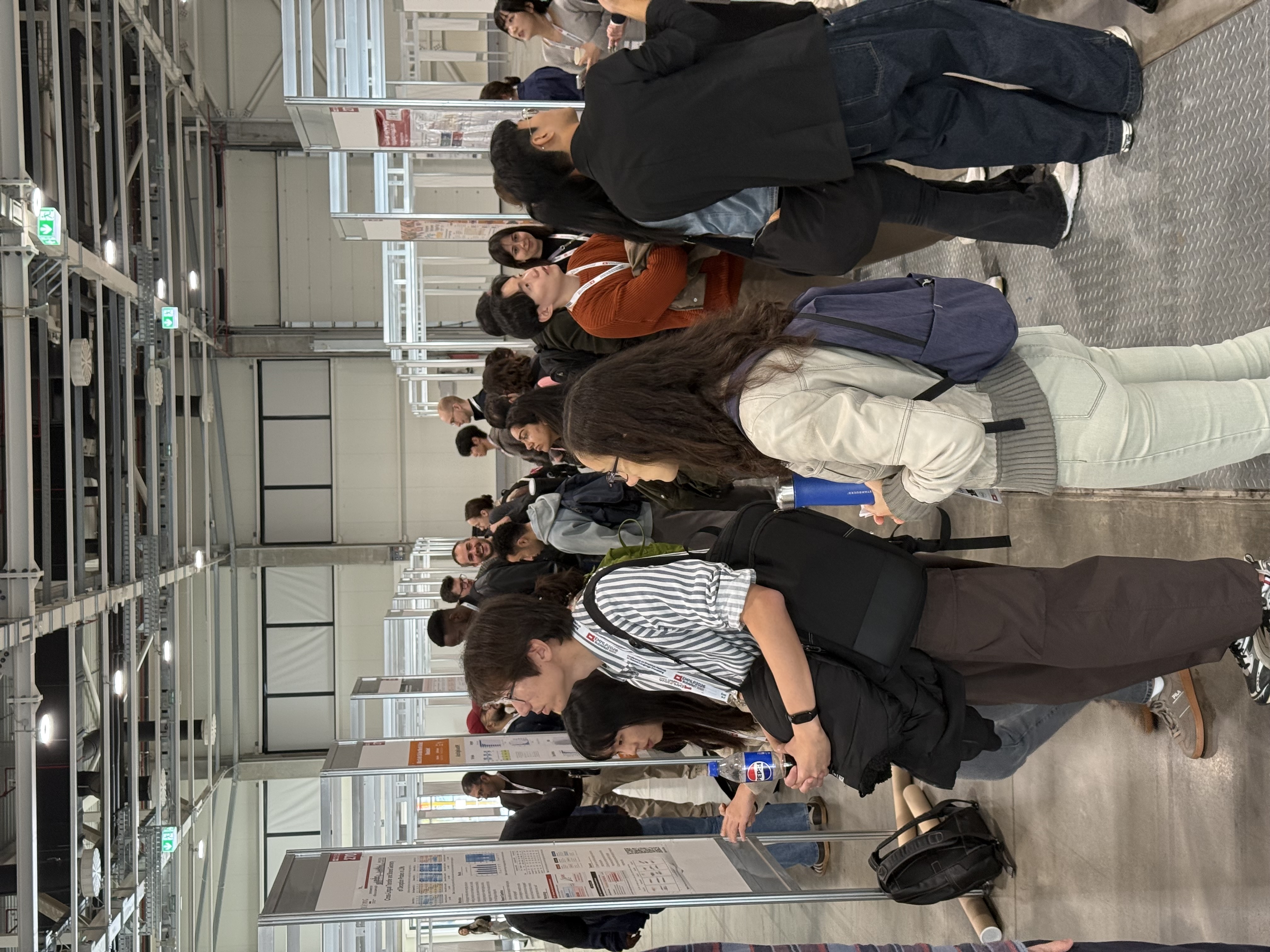
It’s amazing, witnessing researchers actually care: seeing the most creative poster I found at MRL that requires looking through a plastic filter to discern its contents, a passionate chat with someone about multilingual data after my poster presentation, random research conversations with strangers in the shuttle bus on the way home from Hungexpo, our collective frustration on job prospects after PhD, passionate debates during keynote Q&A and oral sessions, and many other human things. LLMs might produce the most perfectly ablated set of experiments, but there’s this underlying mood or concern (or Sorge as how Heidegger puts it) that only us human researchers can embody.
I enjoy the research process and like the community that comes with it, and I’d like to keep doing this many years from now.
Traveling around Budapest
No conference would be complete without a post-work trip! My wife joined me after the conference to explore what Budapest has to offer. The city is amazing, in some ways it reminds me of Vienna1 but with more edge and character. It is a place of contrasts: some places near Blaha Lujza tér straight up reminded me of Novaliches in the Philippines with all its grafitti-filled walls and dark alleyways, and then, you cross the Danube and you’ll find the Castle District which is very historical and Cambridge-like in some way.
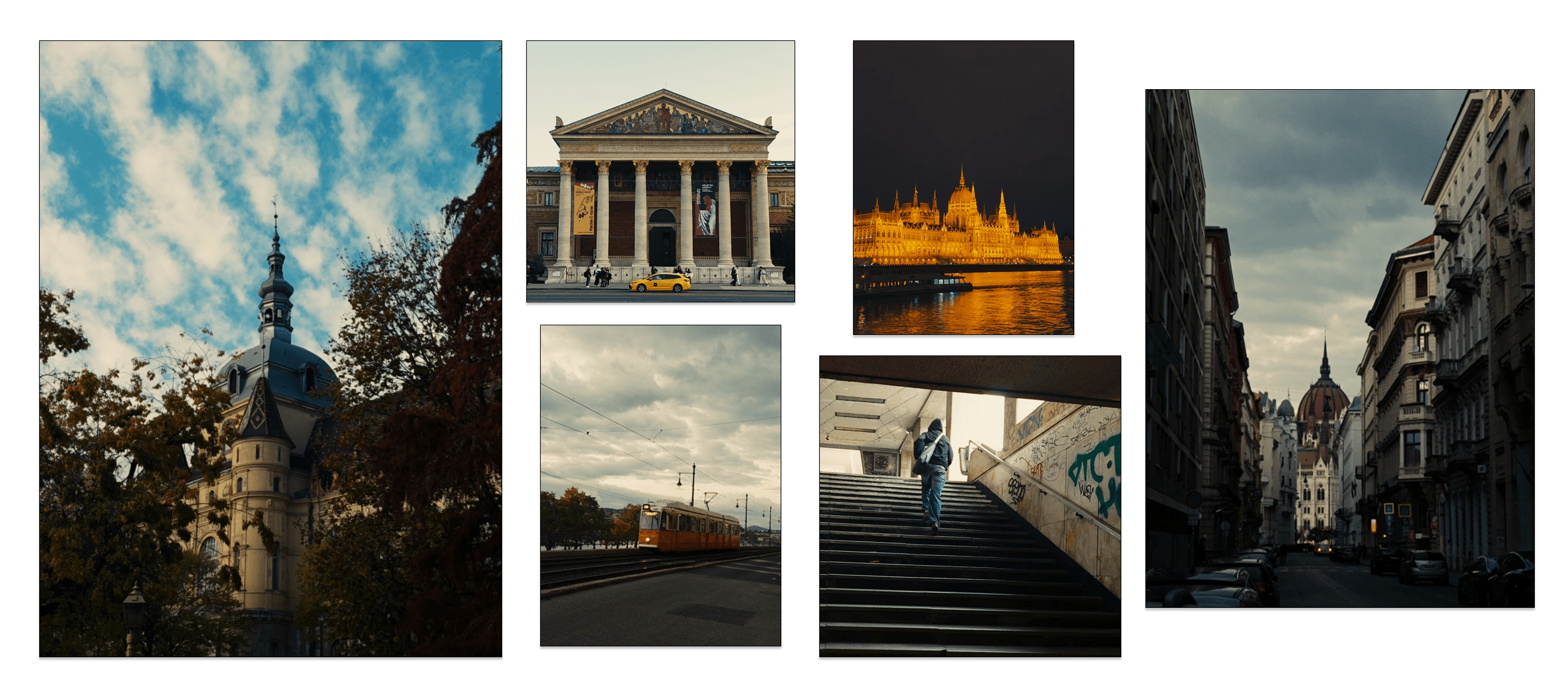
As for the people: one of the most common stereotypes I read about Hungarians is that they are cold and rude on the outside but are actually warm once you get to know them. I think it is true for the city as a whole. I admit that we encountered some bits of rude and mean personalities during our first day exploring, to the point where we almost want to “leave it all behind” and travel to a nearby country instead. However, as we discover the place further, we find that you can find warmth and hospitality in various places. Shoutout to our Airbnb host, the folks at Folk Art Shop, and many others we met that made the Budapest stay so wonderful!
The food is, of course, amazing. Throughout my whole stay I ate kürtőskalács (chimney cake), lángos, and chicken parikash. I realized that the best chimney cake is the one being sold near metro stations and that they taste better when it’s not hot. In addition, lángos is now my new guilty pleasure, the best ones I’ve tasted is in Lángos Center (very local and authentic). Interestingly, there are also a lot of Chinese canteens that offer the usual share of Eastern cuisine in various areas in Budapest— we surprisingly enjoyed these and wondered the lack of such places in Cambridge. Hungarian cuisine is wonderful and it’s now one of my new favorites!
Overall, Budapest for me is a place that takes its time to show its charm. I’m happy that EMNLP has chosen this city as its venue, and I look forward to visiting this city again.
-
My first conference was ACL 2025 in Vienna. ↩